Legacy: From Mordor to Dungeon Synth
\Where the Thread Runs Now
Set the politics aside for a moment and follow the music instead. Summoning's keyboard-forward, drum-programmed sound didn't just spawn epic black metal it also feeds directly into dungeon synth, the lo-fi, keyboard-only genre that emerged partly from black metal's own outtakes and side-projects in the early-to-mid 1990s. Dungeon synth's whole aesthetic — imagined medieval fortresses, wind over empty ramparts, RPG-manual cover art — is downstream of exactly the Mordor/Isengard/Minas Morgul imagery this article has been tracing, stripped down to synthesizer and reverb alone, with the guitars and drums that still anchored Summoning's sound removed entirely.
Mortiis: The Troll in the Dungeon
The genre's most fully-formed early architect wasn't Summoning at all, but Mortiis — the solo project of Håvard Ellefsen, who played bass on Emperor's earliest demo and EP material before being let go from the black metal band around 1992. Rather than join or form another guitar band, Ellefsen went fully solo and fully electronic, composing what he himself called "dark dungeon music" entirely on synthesizers. His so-called "Era I" run of albums — "Født til å Herske" (1994), "Ånden Som Gjorde Opprør" (1995), and "Keiser av en Dimensjon Ukjent" (1995), tracks routinely running past eighteen minutes each — built an entire visual and sonic mythology around trolls, towers, and subterranean kingdoms, performed live and in photographs behind an elaborate prosthetic troll mask Ellefsen designed and wears to this day.
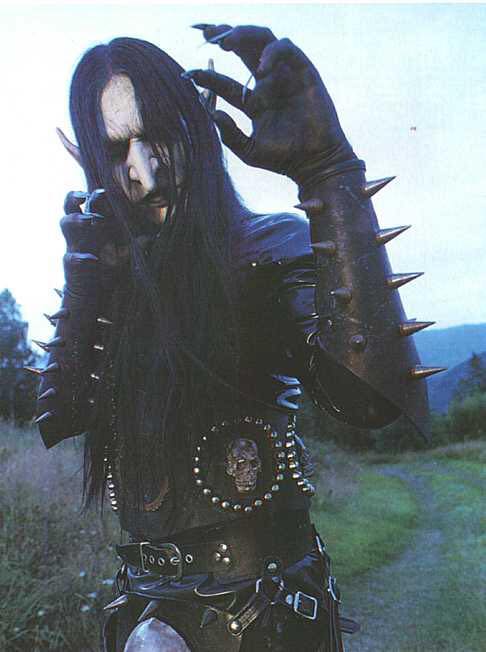
It's worth being precise here about the specific source of Mortiis's imagery: Ellefsen has said plainly that his troll persona draws on Norwegian folklore rather than Tolkien directly, and it would be a stretch to call Mortiis himself a "Tolkien" artist in the way Summoning is. But the aesthetic vocabulary he assembled — underground fortresses, wind-scoured ruins, an implied deep pseudo-medieval history behind every track title — is functionally identical to the Mordor-and-Isengard atmosphere the rest of this article has discussed, and it's this shared vocabulary, more than any specific textual debt, that let dungeon synth and Tolkien-themed black metal grow up as close cousins rather than unrelated genres.
Running parallel to Mortiis, Satyricon's Sigurd "Satyr" Wongraven released the more melodic, folk-tinged "Fjelltronen" (1995) under his own surname, and the German project Depressive Silence released a colder, more melancholic variant in 1996 — between the three of them, all directly descended from black metal bands, the genre's basic template was fully established before the decade was out. Burzum's own contribution belongs here aswell, with the same caveat about direct Tolkien content. After Vikernes's 1994 conviction, his prison-era recordings — most notably 1996's "Filosofem" and the explicitly ambient material that followed — replaced Burzum's earlier raw black metal with slow, droning synthesizer pieces frequently cited, alongside Mortiis, as the foundation of dungeon synth's sound, whatever one makes of the man responsible for them. The uncomfortable fact that two of the genre's foundational figures are Ellefsen (whose imagery is folkloric, not Tolkienian) and Vikernes (a convicted murderer, is itself worth sitting with: dungeon synth's Middle-earth-adjacent atmosphere was, in its founding decade, mostly "borrowed atmosphere" rather than direct textual engagement — proof that by the mid-1990s, "sounding like Mordor" had already become detachable from Mordor itself, a mood any sufficiently isolated black metal musician with a synthesizer could produce.
The Shire Reclaimed: Hole Dweller and the Hobbit's Turn
If early dungeon synth borrowed Middle-earth's mood without its text, the genre's more recent wave has gone the other way entirely — and in doing so, it has finally gone somewhere black metal proper never did. So far, across this history, no artist has ever reached for the Shire directly, for Bilbo's pantry, or for anything resembling comfort. Dungeon synth is where that finally changes.

Hole Dweller, the project of Tim Rowland, now based in Athens, Georgia, is the clearest case. Rowland had already released a Dark Souls-themed dungeon synth album as Bellkeeper (and would later record under a third name, Spell of Unseeing) before starting Hole Dweller in 2019, and the origin story is disarmingly literal: he was deep into "The Lord of the Rings Online" at the time, playing a hobbit character named Jamwine, and wrote the debut with his music software open in one window and the game running in another, composing at whichever in-game Shire location the song was about. The result, "Flies the Coop", follows Jamwine leaving his home in Frogmorton with nothing but a longpipe and a walking stick — a premise that sounds almost like a joke next to Burzum's Black Speech or Gorgoroth's Mordor plateau, and is entirely sincere. Rowland has said his usual dungeon synth influences (Secret Stairways, Depressive Silence — the same Depressive Silence discussed above, one more small thread tying this whole article together, and Jim Kirkwood) barely apply to this specific project; with Hole Dweller, he's said, the influence was the Shire itself, not any prior musician's version of it. Two sequel albums and an EP have continued Jamwine's story since — mandolin joining the synths on 2023's "Crossroads" as he heads toward the Old Forest, a third full album, "Flies the Coop III", following in 2024 — each one, by Rowland's own admission, mixing Tolkien with whatever else the story needed. Musically, that shows: Hole Dweller's sound is warm, lo-fi, and unmistakably gentle, closer to a half-remembered lullaby than to anything from Mortiis's troll-masked catalog, proof that the Shire needed its own register entirely — dungeon synth had to soften considerably before it could actually sound like home rather than a ruin.
Grimdor and Frostgard: Mapping the Whole Legendarium
Two further projects show just how far dungeon synth's Tolkien engagement can stretch once a band stops picking a single region and starts trying to cover the map — and, increasingly, start working together.
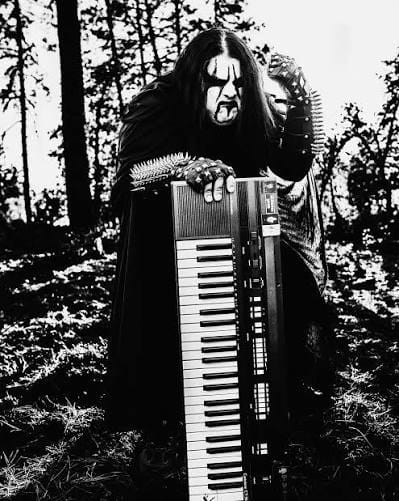
Grimdor, a two-person project active since 2016 with members based in the United States and Germany, describes itself on its own releases as "Tolkien Black Metal Dungeon Synth," and its catalog, running past eighty releases, is the broadest single-band survey of Middle-earth in this entire article. Where Summoning parked in Mordor and the First Age, Grimdor's track list wanders the whole continent: Rohan and Isengard material ("Orthanc," "Helm's Deep," "Fangorn Forest," "Escape from Orthanc"); "The Hobbit"'s own geography on "King Under the Mountain," the dwarf-kingdom of Erebor Bilbo and Thorin's company set out to reclaim; opening-chapter Shire material lifted straight from "The Fellowship of the Ring"'s table of contents, including a track simply titled "A Long-Expected Party"; domestic, almost cozy pieces like "In the House of Tom Bombadil"; Mordor and Angmar material on "Lord of the Nazgûl"; and, on the EP "Stone of the Hapless", an entire release built around "The Children of Húrin" — with song titles ("Black Thorn of Brethil," referencing the forest where Túrin's story ends) that only make sense to someone who has actually read that bleakest of Tolkien's tales. Few if any other bands in this history have been willing to write a song about Tom Bombadil's house in the same catalog as a song about the curse on the House of Húrin; Grimdor treats the entire legendarium as one continuous map, rather than choosing a single dark corner of it to live in.
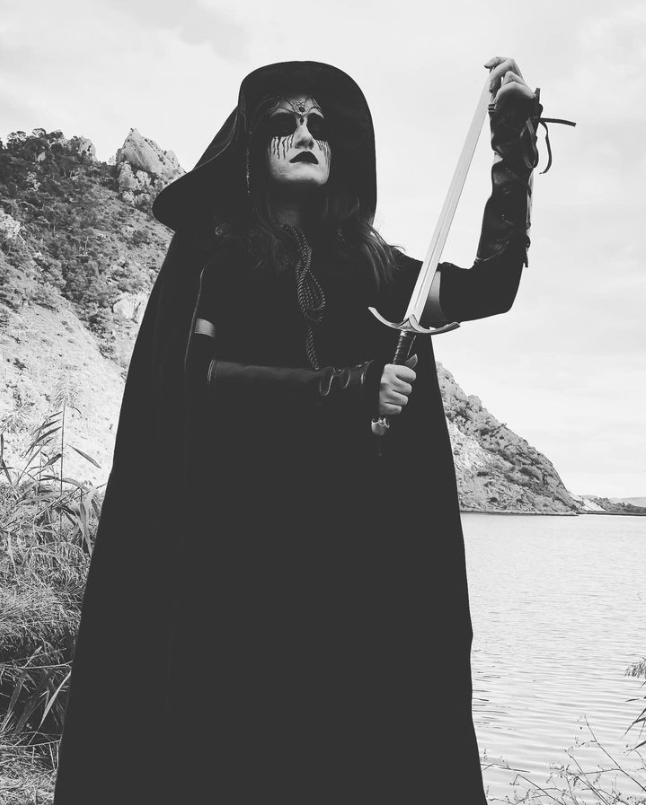
Frostgard, a solo project from Gironès, Spain, is the deepest single dive into material most casual readers of "The Silmarillion" skip past entirely — and a personal favorite of mine. The project's own bio states its premise directly: a persona describing itself as a Dark Elf who has wandered the forests of Beleriand without ever having seen the light of Valinor — a line that is also, quietly, accurate Tolkien lore. The Dark Elves, or Moriquendi, are specifically those Elves who began the Great Journey west toward Valinor but never completed it, and so never beheld the light of the Two Trees that the High Elves carried back to Middle-earth in gem-form as the Silmarils — a distinction most bands borrowing "elf" as a vague fantasy signifier never bother getting right. Frostgard's track titles read like a tour of the First Age's least-visited corners: the two-part "Valaquenta", named directly for the section of "The Silmarillion" that catalogs the Valar and Maiar before any history of Elves or Men even starts; "Anadûnê," the Adûnaic — the Númenóreans' own tongue — name for Númenor itself; and "Coranar", titled for the Elvish solar-year Tolkien describes in the appendices, its nine tracks named for each of the year's Elvish seasons in turn. Grimdor and Frostgard have, fittingly, met in the middle: the two collaborated directly on a joint release, "The Fortress of Utumno", built around Melkor's original stronghold, predating even Angband — proof that this current generation isn't just working in parallel on the same imagined world, but occasionally sitting down to build a corner of it together. Where Grimdor goes wide, Frostgard goes narrow and deep, and between them they show just how much room dungeon synth has made for Tolkien's footnotes, not just his headlines.
A Reusable Template
By the 2010s, as Caladan Brood's Malazan-themed "Echoes of Battle" demonstrates, Tolkien-derived black metal had generalized into a reusable musical format that no longer required Tolkien at all — proof that Summoning's real invention wasn't a lyrical subject but a "sound", one flexible enough to carry any sufficiently epic secondary world.
Dungeon synth underwent the same generalization on its own separate track, and by the genre's Bandcamp-driven revival in the 2020s, "sounding medieval" had become a fully portable aesthetic available to anyone with a synthesizer, regardless of whether Tolkien, Norwegian folklore, or nothing in particular sat behind any individual artist's imagined dungeon. The line from Burzum's prison recordings and Mortiis's troll-masked albums, through Hole Dweller's Shire and Grimdor and Frostgard's far wider and deeper maps of Middle-earth, to a current Bandcamp tag with hundreds of active releases, runs, at almost every step, straight through the same imagery this zine has spent five issues tracing — and now, finally, through the parts of it that were always safe to love.
Signup to our newsletter and Social Media
Below you can sign up to our newsletter(s) one of those is The Infernal Records, a weekly newsletter where Fractal our dedicated researcher finds new releases of the previous week that are worth your time. You can sign up here:
We also love to hear your thoughts and opinions on our articles, so feel free to follow us on our social media channels. Or join us on Black Metal Promotions, Discord. Where we talk about all things black metal.
You can find us on the following social media outlets:
Facebook: https://www.facebook.com/blackmetalzine/
Instagram https://www.instagram.com/blackmetal.zine/
Threads: https://www.threads.com/@blackmetal.zine