Part 1 and 2 here:
 Michael
 Michael
Part 3: Summoning - The True Guardians of Middle-Earth
Before getting into the history, it should be stated outright that summoning is not just one entry in this history, but rather they are possibly the single most important Tolkien-themed black metal band that has ever existed. If I had to pick one band that embodied Tolkien’s legendarium and did so with the integrity it deserves, it would be summoning. That is an enormous claim to make about a two-person black metal project that has never played a single live show, I know. But the rest of this article will be an attempt to show why it's a defensible hill to die on.
Summoning's two permanent members both arrived from adjacent but distinct corners of the Austrian black metal underground. Richard Lederer (Protector), had played drums in a thrash/death metal band called “Marlignom” and completed four years of formal percussion study at music school. Michael Gregor (Silenius), had played in a doom metal band called “Shadow Vale” at sixteen and studied piano for several years, a classically-trained ear that would later show up directly in the band's orchestral keyboard writing. The two also crossed paths through Die Verbannten Kinder Evas, an earlier shared project, before Summoning proper existed.
Silenius's other major connection during this period was to Abigor, the more overtly Satanic Austrian black metal band founded with Thomas "T.T." Tannenberger; Silenius handled all of Abigor's vocals on official releases through 1999 and again from 2020 until the present date. This connection matters directly to Summoning's existence: Abigor's debut was recorded for a young Austrian label called Napalm Records, and it was through that relationship that Silenius secured Napalm's interest in releasing Summoning's own debut. Without Abigor, in other words, there may have been no commercial outlet for Summoning at all, a reminder that even the genre's most singular project didn't emerge from nowhere, but out of the same small, overlapping Austrian black metal underground as its more conventionally Satanic peers.
Before any album existed, the fledgling band consisting of Silenius, Protector, and drummer Alexander "Trifixion" Trondl recorded two demo tapes, "Upon the Viking's Stallion" and "Anno Mortiri Domini", plus a split release with the Austrian band Pazuzu titled "The Urilia Text". Almost none of this material would resurface later in anything like its original form; the demos reportedly sold well out of a single Vienna record shop, a detail that captures just how underground the band's earliest existence really was, for years, Summoning existed almost entirely on cassette, sold across a shop counter, before any wider audience heard a note of it.
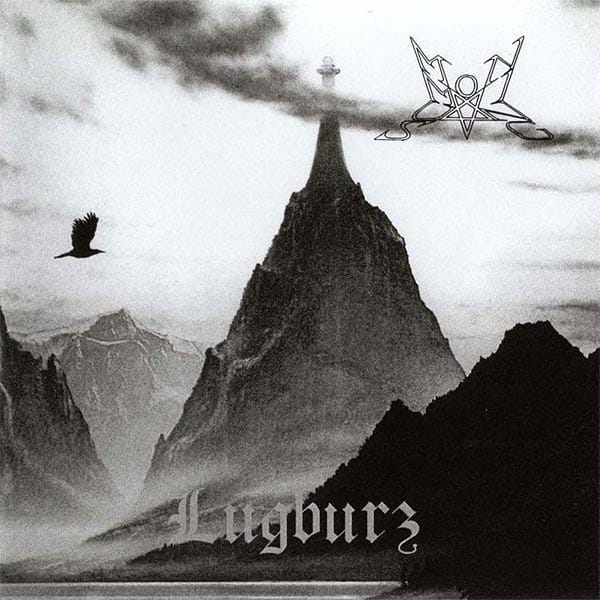
Lugburz (1995)
Summoning's actual debut full-length, “Lugburz”, arrived through Napalm Records in 1995. The title is Black Speech for "Dark Tower", an orc name for Barad-dûr, Sauron's own fortress-seat within Mordor and the album's cover uses Mark Harrison artwork created for Roger Taylor's fantasy novel “The Fall of Fyorlund”.
What surprises most new listeners who come to "Lugburz" after any later Summoning record is how conventional it sounds: fast, raw, Nordic-style second-wave black metal, closer in spirit to Abigor than to anything resembling "epic black metal." There is no wall of keyboards yet, no slowed bombastic drum programming. Just fast tremolo riffing, blast beats, subtle synth sections and Silenius's shrieking. A young Austrian band still working within the genre's existing sonic conventions rather than inventing new ones. What was already fully formed, though, was the lyrical commitment: this was, from the first song, an album about Middle-earth, not a black metal album with a few fantasy asides. Napalm's own retrospective marketing copy has since credited "Lugburz" with laying the blueprint for the entire modern Tolkien-black-metal movement, a claim that's self-interested coming from the band's own label, but not for that reason inaccurate.
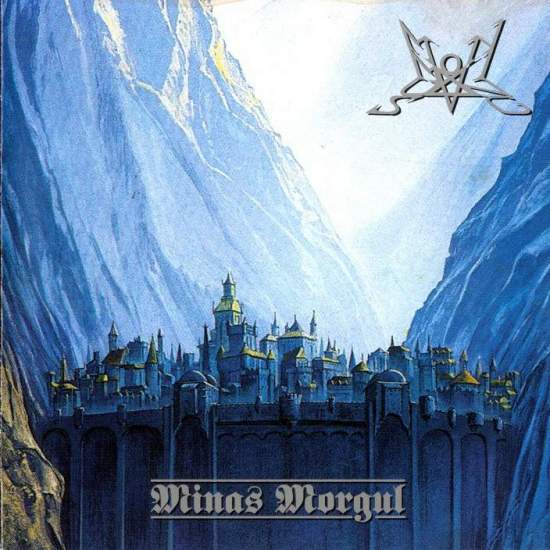
Minas Morgul (1995)
The same year, Summoning released a second album that many fans, and, by their own later account, the band itself, consider the true debut: "Minas Morgul", named for the Nazgûl's corrupted tower-fortress, formerly Minas Ithil of Gondor before its capture and defilement, a place whose very name, "Tower of Dark Sorcery," replacing its original meaning "Tower of the Rising Moon", is itself a small piece of Tolkien lore about corruption renaming what it conquers. Drummer Trifixion had departed, and rather than recruit a replacement, Silenius and Protector began programming drums themselves and building songs around dense, multi-layered keyboards standing in for orchestral and medieval instrumentation, a decision born partly out of necessity that became the band's defining innovation. The tracklist alone reads like a guided tour of Middle-earth's darkest corners: "Lugburz," "The Passing of the Grey Company," "Morthond" (the river valley below Erech), "Orthanc" (Saruman's tower within Isengard), "Ungolianth" (their own spelling of Ungoliant, the primordial spider-demon who predates and dwarfs even Shelob), "Dagor Bragollach" (the "Battle of Sudden Flame" from "The Silmarillion"'s First Age, in which Morgoth's fire-rivers of Thangorodrim break a centuries-long siege in a single night), and "Dor Daedeloth," Morgoth's own realm.
Musically, this is where the template that would define the band, and later an entire subgenre, first fully appears: shrieked vocals buried under reverb until they read as distant and spectral rather than aggressive, minimal guitar work subordinated to dominant synthesizer melody, and a slow, bombastic sense of scale entirely unlike the frantic pace of "Lugburz". It's worth pausing on how strange a creative decision this was in 1995: Norwegian and Swedish black metal at the time was defined by speed and raw aggression; Summoning chose, in their very first mature statement, to slow down and let synthesizers carry the emotional weight instead, a decision that could easily have read as a retreat from "real" black metal, and that instead became the single most imitated sound the genre's Tolkien wing has ever produced.
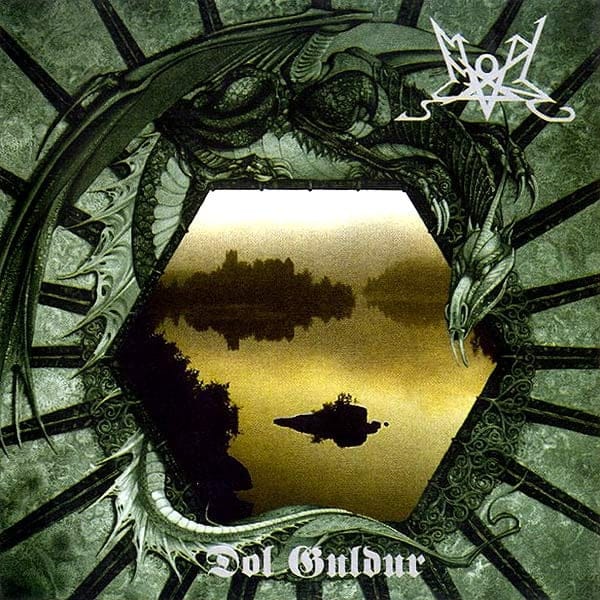
Dol Guldur (1997)
“Dol Guldur”, named for the ruined fortress of the Necromancer in southern Mirkwood (later revealed in “The Lord of the Rings” appendices to be Sauron himself, hiding and regathering strength centuries before the War of the Ring), continued the “Minas Morgul” approach and deepened the band's relationship to its source material in an unusually literal way: the album's lyrics were largely written by P.K. of Abigor, but with several passages drawn directly from and credited to J.R.R. Tolkien himself in the album booklet, an explicit acknowledgment of authorship that few, if any, other bands in this entire history bothered to make.
Stay tuned, next week we will finish looking at the rest of Summoning's discography and a conclusion on Summoning as the true guardians of Middle-Earth.
 Michael
Chapter 4 will be online soon.
Signup to our newsletter and Social Media
Below you can sign up to our newsletter(s) one of those is The Infernal Records, a weekly newsletter where Fractal our dedicated researcher finds new releases of the previous week that are worth your time. You can sign up here:
We also love to hear your thoughts and opinions on our articles, so feel free to follow us on our social media channels. Or join us on Black Metal Promotions, Discord. Where we talk about all things black metal.
You can find us on the following social media outlets:
Facebook: https://www.facebook.com/blackmetalzine/
Instagram https://www.instagram.com/blackmetal.zine/
Threads: https://www.threads.com/@blackmetal.zine